The post How Are You A Great Detective During Client Meetings? appeared first on .
]]>
My story:
After more than two decades of countless client meetings, I often don’t stick to the same checklist of questions that I used to.
Totally true–one of the latest questions I asked my client was “Why do you keep a semi-automatic pistol in your office?”
His answer revealed more to me about how much his business means to him than the majority of questions I had asked, and from that point on I knew HOW to frame my interviews with that specific company, that specific owner.
I listen a lot more now, use more analogies, get to know the PERSON who’s in charge, not just the company’s products.
BUT at the same time, I also ask better questions regarding the company’s products, including their inventory, shipments, sales tracking and profit margins–whatever the client is willing to reveal to me without my going over the line. As I get older, I’m learning how to push that line further and further to get more information that will ultimately benefit my client.
I look at EVERYTHING in the room, whether we’re meeting in a small office or a large warehouse.
I watch the boss’ interaction with the workers.
I check out their technology–are they on the latest Macs or on old Windows 95 computers? Is the person in charge adept at gadgets or would he rather use pen and paper? Should I design the website so it will also look great on the client’s SVGA monitor, as well as on 1920 x 1200 monitors?
What’s the story behind their company’s name?
The post How Are You A Great Detective During Client Meetings? appeared first on .
]]>The post Sports and the SWOT Analysis appeared first on .
]]>
I’m currently watching the Golden State Warriors play at Houston against the Rockets.
Whenever a basketball team I’m following is behind around halfway through the game, I look at the score, but I look at something else. WHO IS IN FOUL TROUBLE.
Why?
Because the ability of a team to have all its players on the court toward THE END of the game is more important than the beginning, because the final score is all that matters.
If the Warriors are behind by 10 points in the third quarter but NONE of their star players are in foul trouble (2 or less fouls each), then they can be AGGRESSIVE and TAKE CHANCES with both their offense and defense, because they have at least 3 more fouls to give.
But if their star players have 3 or even 4 fouls, then their actions are hampered, crippled even.
SWOT stands for Strengths, Weaknesses, Opportunities and Threats. In terms of the Warriors, their Strengths would be their defense, shooting and strategy. Their weaknesses would include shooting slumps, and more importantly, their fiery power forward Draymond Green’s foul trouble, since he’s instrumental in their winning another championship.
If Green has less than 3 fouls in the third quarter AND is playing steady, then the Warriors will probably win. Period.
Sometimes the game isn’t as much in the current score, but in the ability to stay in the game until the end.
The post Sports and the SWOT Analysis appeared first on .
]]>The post A Constant Gardener appeared first on .
]]>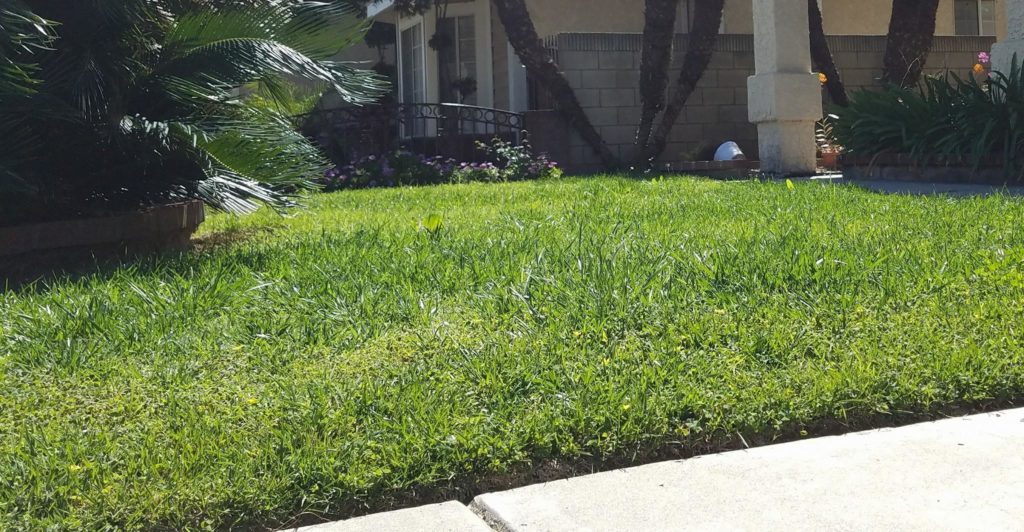
This is a picture of our lawn after not being mowed and edged for a little over a week, because the gardener couldn’t come over on Wednesday because it rained. I saw the lawn when I bent over to pick up the community newspaper, and noticed how quickly the grass had grown and become unruly.
If I hadn’t seen it at that moment and instead looked at it next Thursday, I would have assumed that the lawn had never changed, simply because I wasn’t paying attention.
It’s the same for a business. Things that we take for granted as being automatic still need attention, especially during rare moments, like rain in Los Angeles. Tasks that we begin, we don’t continue, in lieu of other, “more important” tasks.
We tend to start blogs and after a few weeks or months, simply stop writing them anymore. We forget to update our portfolio after a project finishes. We develop momentum with Facebook and LinkedIn, but forget that we also have to continue to create content for Instagram, Twitter, Behance and Alignable.
Having said all that, I’m going to offer some quick tips and shortcuts on how you can keep your content fresh, sort of like taking 10 minutes to run the weed wacker on your lawn or pruning some stray branches.
- Create a 1080 x 1080 pixel square in Photoshop and fill that square with an image from your latest project, then save it as a jpg file. If you don’t have Photoshop, take a picture of your latest project, then square it up on your phone. Then post that picture to your accounts on Instagram, Facebook, Behance, LinkedIn, and so on.
- When you finish a project and if your client is on LinkedIn, ask them to write a quick recommendation for you. If you have a Yelp page, same thing. It’s amazing how many people (including me) should have a lot more testimonials on their website and social accounts if we only remembered to do this.
- If your client doesn’t have time to write but can say nice things about you on the phone, write it down and then ask your client permission for you to post it as a quick testimonial on your website, either as a pull quote or added to your testimonials page.
- Do a Facebook live session talking about your newly-completed project, then save that as a video file, upload it to YouTube, and embed the YouTube video on your own website, as well as all your social network accounts.
- If you have a WordPress site, install social feed plugins on your site. Whenever you update one of your social media accounts, your website gets updated also. https://wordpress.org/plugins/tags/social-media-feed/
- Instead of rewriting your bio on different social media accounts, create a MASTER BIOGRAPHY FILE of yourself, and write everything you can think of to describe yourself. From that master file, you can now copy and paste snippets to fill your bio descriptions on your different social accounts, deleting copy to fit within the character limitations of each account.
- While you’re at it, compile different photos of yourself, your company’s logo and banner, and keep all of them in one, quickly accessible folder in your computer.
Since I got serious about tending to my social media accounts, I’ve actually created a SOCIAL NETWORK folder, and within it folders for Facebook, LinkedIn, Instagram, etc., and a folder for miscellaneous memes that I may want to sprinkle in just for fun.
Most of these tasks don’t take that much time, and you’ll be able to repurpose the content multiple times. The trick is to have some kind of plan, have a little bit of time for seeding, a little bit of time for pruning, and a proper tool belt for your gardening gear.
The post A Constant Gardener appeared first on .
]]>The post Falling Off the Humble Wagon appeared first on .
]]>
One of my colleagues had a saying, “Finish it first, and then tell everyone else about it.”
It goes against everything that my ego wants me to do, but in the long run it helps to avoid embarrassment.
I use the same philosophy when I hear wonderful news about a project that I’m about to work on.
When that happens I shut up, cautiously, optimistically.
I do the work.
I wait for the client’s approval.
I wait for the client’s check.
I cash the check.
I breathe a sigh of relief.
Then I talk about it, after the fact.
All bases covered, no need to backtrack on anything.
I still fall off the humble wagon sometimes, like when I hastily posted a wireframe diagram in Instagram of a project that never got completed (client flaked), and I have since removed it.
I still fall off the humble wagon. But at least I know the wagon is there.
#humility #ego #getpaid #cautiousoptimism #quiet
The post Falling Off the Humble Wagon appeared first on .
]]>The post You Are Not Your Day Planner appeared first on .
]]>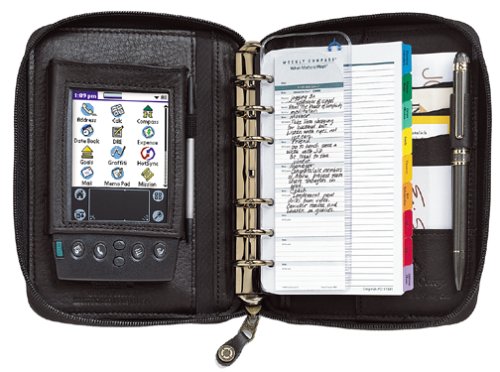
Twenty years ago, I thought that the THINGS that I owned were absolutely necessary for me to do my work. My Palm 7 device, Franklin Planner, Plantronics headset, and the latest “pro” version of every software that money could buy.
I didn’t even use 95% of what I owned–they just looked good sitting on the shelf or tabletop.
Since then, I’ve deconstructed my approach to work and the gadgets I use. Do these things make me unique compared to the competition? Do these things increase my actual value to my clients? Do these things help me solve problems?
By distilling the THINGS that I use down to the fewest items, or getting rid of them altogether except for a pen and pad of paper, I am forced to distill each problem into its essence, and find a simple solution that can be understood by written words or sketched diagrams, without the distraction of things.
I don’t need a gadget to get me to that AHA! moment.
I am not my mobile device.
I am not my Adobe Creative Suite.
I am not my Day Planner.
#office #business #gadgets #franklinplanner #dailyplanner #dayplanner #skills
The post You Are Not Your Day Planner appeared first on .
]]>